
Some time ago, after watching Max on Analogue Insights on YouTube do a review of the Agfa Optima 1035 Sensor I acquired one at a good price off Ebay. As a lightweight and compact camera it is ideal for Street Photography. More recently I have also purchased an Olympus Trip 35 and the one thing I realised was how similar these two small analogue cameras are in their functionality.
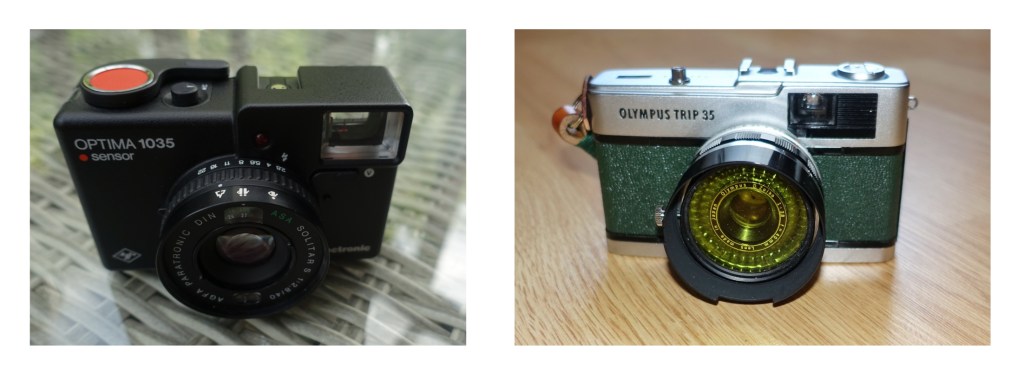
They are quite different in their appearance, the Agfa being made of metal and coated with a black plastic grained paint finish and the Olympus being of metal but with a chrome and leatherette finish.
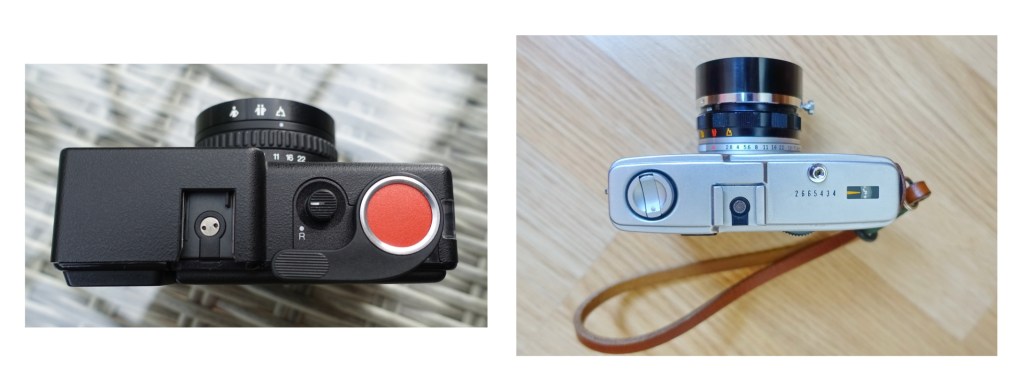
With the the similarities in mind I thought it would be good to do a photo shoot using both cameras to do a direct comparison. I took them out on a Photo Walk in the town of Saffron Walden in Essex, one of my favourite towns as there are a lot of subjects.
Both of these cameras are of a similar size and sit well in the hand. Both use 35mm film and are of a viewfinder style with fixed 40mm lenses. They both have zone focusing with another scale under the lens showing feet and meter focusing scales for more accurate setting of focus.
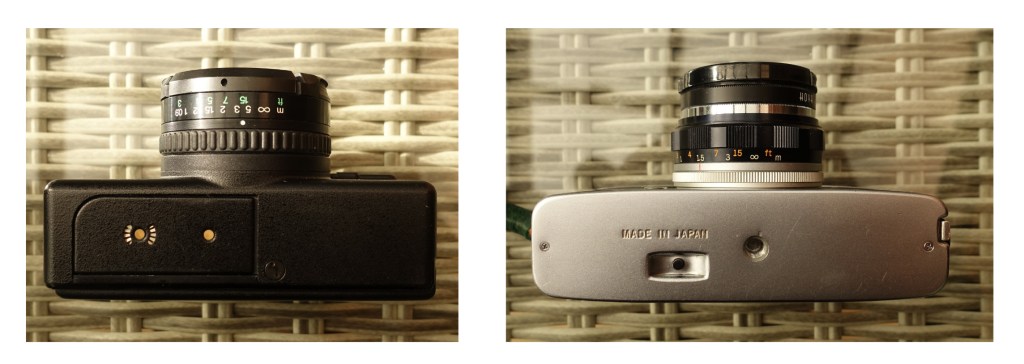
One major difference between the cameras is that the Agfa needs batteries to operate whilst the Trip 35 has a selenium cell meter that doesn’t need any batteries. The Agfa’s batteries are located inside the back cover of the camera so if you need to replace them you have to open the back which is a bit of a nuisance as you then fog the film. The saving grace here though is that the Agfa has a rather neat arrangement whereby you load the film on the right hand spool and then it unloads into a light resistant enclosure to the left so you should only fog one or two frames when changing batteries mid-roll. Not to be recommended that you do it in bright sunlight however.
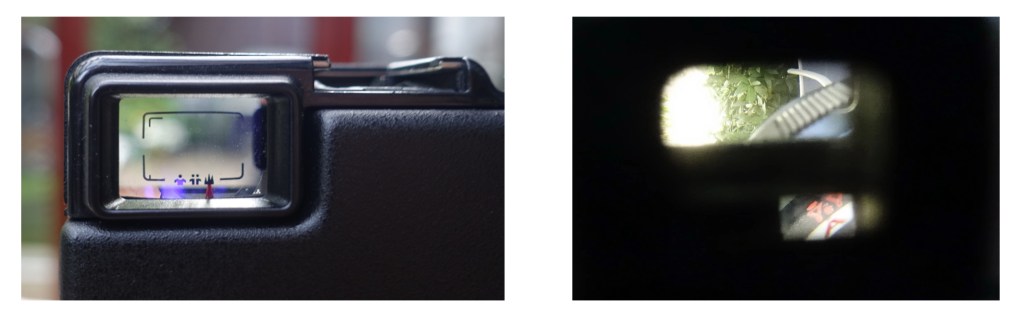
Both cameras have nice, bright viewfinders although the Agfa wins out slightly here with a very bright one with information about the zone focusing. The Trip does have a small mirror in the viewfinder that shows what focus you are on but not as clear as the Agfa.
Agfa Optima 1035 Spec.
Technical Specifications
Type : Film 35 mm camera 24 x 36 mm (35 mm).
Lens: Color – Solitar S f2.8 / 40 mm ( 4-element) with multi-layer coating (MC), ØS 49 mm x 0.75, distance range 0.9 m – Infinity.
Shutter: Electronic Paratronic shutter 15-1/1000 sec.
Automatic exposure: Fully automatic and infinitely variable control of shutter times and aperture.
Exposure control : Green signal 1/30-1 / 1000 sec. Red signal 1 / 30-15 sec.
Film Sensitivity : 15-28 DIN 25-500 ASA.
Viewfinder: (V1: 0.78) with parallax marks, distance symbols reflected.
Flash: Flash time setting when the flash unit is pushed in, manual aperture setting via quick switch lever, acoustic rewind control. Self-timer.
10 sec delay time with optical release – advance notice.
Filter size: 49mm.
Dimensions: 102 (width) x 69 (height) x 55 mm (depth) Weight 305 grams.
Olympus Trip 35
Technical Specifications
Film size: 24 × 36 mm (35mm).
Lens: D. Zuiko F2.8, 40 mm. (4 elements in 3 groups).
Shutter: Programmed system. Automatic: 1/40 sec. or 1/200 sec. Manual: 1/40 sec. X sync.
Film rewinding: Crank type with rewinding button setting system.
Focusing: Zone focusing system (4 zone indicators) with distance scale (in meters and feet).
Exposure meter: Automatic exposure adjustment by built-in electric eye meter.
Light measuring range: EV 8 – EV 17 (ASA 100).
Film speed setting: ASA 25 – 400.
Filter size: 43.5 mm (screw-in).
Accessory shoe: Cordless flash contact.
Viewfinder: Luminous bright frame finder (Magnification 0.55) with parallax correction mark and zone indicators.
Film winding: Rear wind-on wheel. Self-cocking to prevent double advances and double exposures.
Size & weight: 115 (width) × 70 (height) × 56 mm (depth) Weight: 410 grams.
So, with a roll of Fomapan 200 loaded in both cameras off I went to Saffron Walden to shoot some images. Here are the results. I used Fomapan 200 film and processed both rolls in the same tank at the same time to ensure consistency between each film.
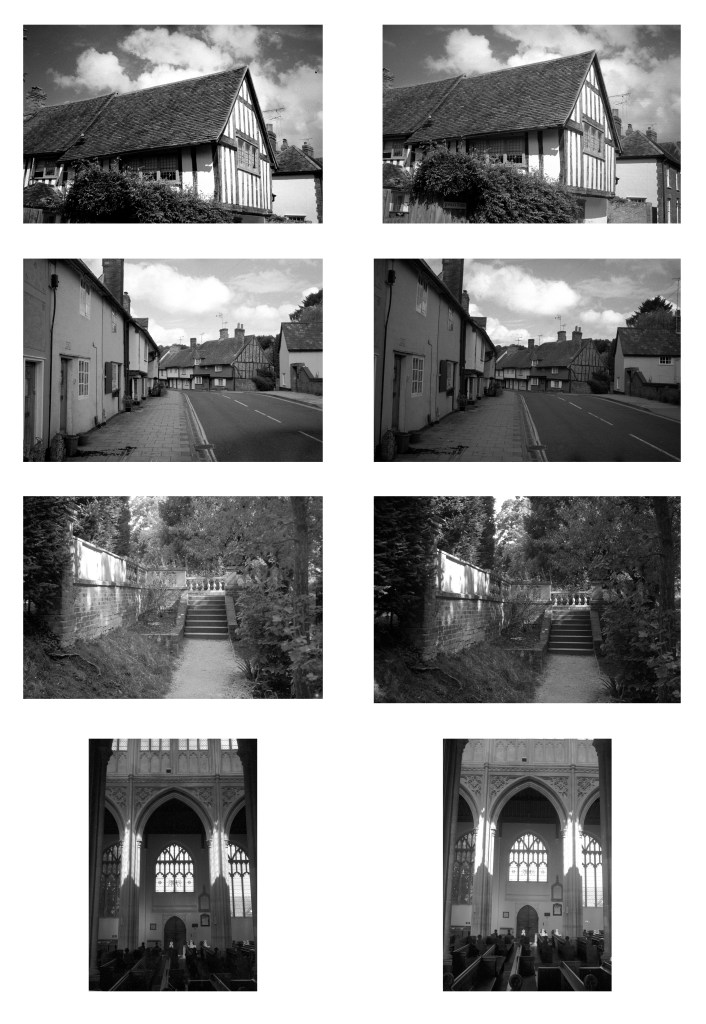
Shutter speed: One of the differences between the two cameras is that the Trip 35 has only two shutter speeds, 1/40th or 1/200th and the Agfa has an infinitely variable electronic shutter. So in theory, the Agfa should be able to handle more different exposure situations. Looking at the difference between Figure 7 and 8 above though I think I prefer the handling of the exposure by the Trip 35 as it seems to have more contrast.
Aperture: Both of these cameras have automatic control of the aperture.
Film Speed: The film speed range can be a bit of a limitation on these cameras if, like me, you are in the habit of wanting to push film to 800 or 1600 ASA. The Trip 35 only goes as far as 400 ASA and the Agfa to 500 ASA.
Both of these cameras handle a situation on a sunny day and give pretty good results on indoor settings. The Trip 35 locks if it considers the light level too low but you can fool it by just putting the setting on the lens barrel from automatic to f2.8 which is the flash setting and it will then use the 1/40th second shutter speed. The Agfa will just adjust the settings to handle the available light. It does though have a warning light in the viewfinder which flashes green for what it considers a suitable light level and red for insufficient light. It will still take an image.
Filter size: Another difference here is that the Olympus in the Trip 35 have gone for a rather unusual 43.5mm filter size whilst the Agfa has the more traditional 49mm. I think maybe that Olympus were aiming to make more by selling their own filters to suit this unusual thread size. You can however still get some 43.5 size filters on some auction sites online and there is also the option of purchasing a stepping ring to change up to 49mm so not a big problem.
Conclusion.
So, in conclusion, which of these two cameras do I prefer? That’s a very difficult question to answer as I like both of these little cameras very much and am using both. But, at the moment I think I’m favouring the Olympus Trip 35 but I’m not sure why. Maybe it’s the traditional viewfinder styling with satin chrome and the unusual green leatherette finish. This particular Trip was made in 1974. The Agfa Optima is a more futuristic styling based upon German product design of the Schlagheck Schultes design studio in the late 1960s.
Nick Ambrose
Blog site: https://nickambrose.org/
 Nicks Pics
Leave a comment